
SEO analysis
SEO analysis as a basis for good decisions.
Without solid data, SEO stays guesswork. A thorough SEO analysis shows where your website actually stands, what is blocking visibility and which measures offer the greatest leverage. Semtrix reviews technology, content, rankings and competitors and turns the findings into a clear basis for action, readable rather than a flood of data.
Several data sources
The SEO analysis pulls crawl, Search Console, ranking data and competitor comparison into one report.
Assessment, not an error list
Every finding in the SEO analysis comes with an estimate of what it actually costs.
A running order
The SEO analysis ends by saying where to start, and why there of all places.
Fundamentals
What is an SEO analysis?
The SEO analysis is part of the wider SEO optimization and the point where assumptions become decisions. It comes first in any strategy, and again after every unexplained drop.
An SEO analysis is the systematic examination of a website from a search engine optimisation point of view. It checks how well search engines capture the site, where technical and editorial weaknesses sit, which rankings exist and how the site stands within its competitive field. Unlike a plain tool report, a good SEO analysis classifies the findings: which problems genuinely cost visibility, which are cosmetic, and which measures pay off fastest? A crawler reports several thousand notices on a mid-sized website. What matters is not their number but which twenty of them will move something over the next three months. That selection is the actual work.
Semtrix takes SEO personally: a named contact, transparent communication and recommendations sorted by impact. As part of the Eskimoz group, Semtrix combines analytical depth with hands-on delivery experience. Start with a free analysis and find out what potential your website holds.
Semtrix combines data from several sources with specialist judgement: the full crawl from the CrawlR module, positions from the Monitoring module including AI Overview mentions, the link profile against competitors through Notorious, and the numbers from your own Search Console. Where sources contradict each other, that goes in the report rather than one figure quietly winning.
An SEO analysis examines a website's technology, content, rankings, authority and competitive field and assesses the findings professionally. The result is a prioritised roadmap, not an error list.
Key figures
Experience that goes into every SEO analysis.
SEO analysis and GEO
GEO: AI visibility as a discipline of its own.
On request, Semtrix includes AI visibility in the SEO analysis, meaning whether and how a brand appears in AI answer systems. GEO is not an extra column in a ranking report. It is a separate discipline alongside classic SEO, with its own questions and its own metrics.
In practice that means checking, for a selection of typical prompts, whether your brand is named, which sources are cited instead and what claims about you are in circulation. Measurement runs through the LLM Ranking module, with AI Overview monitoring alongside classic keyword tracking. The channel work itself sits with the GEO agency and GEO optimization.
What the classic SEO analysis checks
What the SEO analysis additionally checks in AI systems

The most expensive mistake in an SEO analysis is not the finding you miss. It is the list of 400 items where nobody says which twelve of them touch revenue. After that, usually nothing happens at all.
Why Semtrix
Why have your SEO analysis done by Semtrix?
Semtrix brings 11 years of experience and more than 1,500 delivered projects. The difference shows once analysis turns into work: for evidenz.de we have increased visibility by 147 % and traffic by 1,400 % since the project started in 2022. What came first there was not new content but the decision about which of the identified problems to tackle first.
As part of the Eskimoz group, named Best Large Integrated Search Agency at the European Search Awards 2026, Semtrix combines data skills with delivery experience. The SEO analysis is assessed by specialists, not simply generated. You can see who does the assessing about us, evaluated projects are in our references. If you want the implementation supported afterwards, that offer sits with the SEO agency.
Who it is for
Who should have an SEO analysis?
After a drop in rankings
When positions fall away for no obvious reason, the SEO analysis separates an algorithm update from a technical change and from a content mistake of your own. All three need entirely different answers.
Before a relaunch
Before any rebuild, it has to be documented which URLs carry traffic today and which content holds rankings. The SEO analysis provides that baseline, and without it an SEO relaunch cannot be secured.
When measures show no effect
Regular publishing without ranking movement is almost always a structure or intent problem, not a volume problem. The SEO analysis shows where the work is draining away.
Before starting with an agency
Before budget goes into an agency, what is actually achievable belongs on the table. The SEO analysis provides the basis for effort, sequence and a realistic expectation of the first months.
Our approach
Three questions per finding.
Tools find problems, they do not weigh them. So every finding in the SEO analysis passes the same three questions before it even enters the report. Anything that answers none of them is documented but not prioritised. That keeps the roadmap short enough for someone to actually work through it.
Building blocks
What does the SEO analysis at Semtrix cover?
Six areas that together form one picture. For a broader review including authority and market context, see the SEO audit.
Ranking and keyword analysis
Part of every SEO analysis: current positions, potential and trend, including the keywords where a few places decide whether anyone clicks.
Backlink and authority analysis
Quality and structure of the link profile, compared directly with the domains ranking ahead of you.
Competitor analysis
Comparison with relevant competitors: where they are visible, where you are not, and which gap is worth closing.
Prioritised recommendations
The output of the SEO analysis: clear measures by impact and effort, with ownership and a realistic split between what happens in-house and what does not.
Professionally reviewed by Philip, Search Consultant, specialist area SEO and GEO. Last updated in September 2026.
Measured. Assessed. Sorted.
An SEO analysis whose first page already says what this is about, rather than page forty.




Process
How does working together look?
Four steps from the first conversation to a roadmap you could deliver without us.
Setting the question
Clarifying what the SEO analysis should answer. A ranking drop leads to a different examination than a planned move into new markets.
Analysis
The SEO analysis itself covers technology, content, rankings and competitors, with a full crawl rather than a sample, even on large domains.
Assessment
Professional classification of every finding from the SEO analysis by impact and effort, including the items deliberately left alone and the reason why.
Roadmap
The SEO analysis ends with prioritised recommendations as a basis for decisions, in an order that fits your resources.
Analysis areas
The analysis areas in detail.
Each area of the SEO analysis answers a different question. Only read together do they show why a website stays below its potential.
Technical analysis
The technical review in the SEO analysis answers the basic question of whether search engines see what is on your website at all. It comes first, because every other finding is worthless while a page never reaches the index.
- Crawl of the whole domain, reconciled with sitemap and Search Console
- Status codes, redirect chains and canonicals
- Indexability by page type, including orphaned and excluded pages
- Core Web Vitals from field and lab data
- Rendering and how far content depends on JavaScript
All of them. The CrawlR module captures even large domains in full instead of sampling the first thousand URLs. In shops in particular, the problems rarely sit on the top levels.
Do you need access to Search Console?For a complete picture, yes. Without it, the actual impressions and clicks are missing and the analysis rests on external estimates alone. Read access is enough.
Content analysis
This part of the SEO analysis does not check whether texts are well written, but whether they serve the query they are meant to rank for. The benchmark is the set of pages currently holding the front positions.
- Match between page and search intent for each target keyword
- Semantic gaps against ranking competitors, assessed through Scribe
- Thin and duplicate pages, including candidates for consolidation
- Freshness and maintenance state of existing pages
- Citability: answer blocks, definitions and structure for AI systems
A topic or aspect competitors cover and you do not, although people search for it. Not every gap is worth closing. It is weighed by search volume, closeness to the business and effort.
Do you assess older content as well?Yes, and often with the biggest return. Existing pages already have history and internal links. Reworking them usually pays off faster than a new page on the same topic.
Ranking and keyword analysis
Positions on their own say little. The SEO analysis gets interesting at the question of which keywords bring money, which only bring volume, and where a few places decide visibility.
- Current ranking picture including the trend of recent months
- Keywords on positions four to ten as short-term potential
- Keyword to URL mapping, exposing competing pages
- SERP features and AI Overviews per query
- Match between search intent and the actual page type
That is cannibalisation: two pages serve the same query, rank alternately and both stay below potential. The analysis shows the pairs, the fix is consolidation and a redirect.
Which rankings actually matter?The ones with buying interest or an enquiry behind them. A high-volume research keyword is valuable for reach but does not replace a position on the query that leads to an order.
Backlink and authority analysis
In the SEO analysis the link profile is not judged in isolation but against the domains sitting at the top of your search results. Only the gap makes the number meaningful.
- Profile structure by quality, topical fit and origin
- Anchor text distribution and conspicuous patterns
- Direct competitor comparison through the Notorious module
- Lost and broken links with recovery potential
- Risk findings, documented rather than automatically disavowed
No. What counts is topical fit and the quality of the linking page. A hundred links from irrelevant directories weigh less than one reference from a trade publication in your field.
Will you recommend a disavow?Only on a clear finding. Disavowing too readily costs authority that does not come back. More on building it sits with link marketing by Semtrix.
Competitor analysis
Competition in search is rarely identical to competition in the market. The comparison uses the domains actually sitting on your queries, even where they are not direct rivals.
- Identifying the real SERP competitors per topic area
- Visibility trend compared over several months
- Shared keywords, exclusive keywords and the gap between them
- Content formats and page types that rank in your market
- Mentions in AI answers, side by side
Then the strategy shifts to niches and specific queries where depth counts for more than domain strength. The analysis shows which topic areas are realistically within reach.
How many competitors do you look at?Usually three to five, chosen by overlap in the keyword set. More produces data volume without additional insight.
Your benefits
Your benefits with an SEO analysis from Semtrix.
What changes when an SEO analysis is meant to be worked with rather than filed.
Free analysis
Have your website analysed for free.
The SEO analysis from Semtrix reviews technology, content, rankings and competitors and shows you in a prioritised roadmap which measures bring more visibility.
Team
Here for you in person.
An SEO analysis is only as good as the people reading the data. At Semtrix they sit in Düsseldorf and Essen.




Semtrix by Eskimoz
What the Eskimoz group means for your SEO analysis.
Semtrix is a global search agency: you get found where people search, in classic search as much as in AI answers. Semtrix has been part of the European Eskimoz group since 2024. Nothing changes about how you are looked after, your project stays with a fixed team in Düsseldorf or Essen.
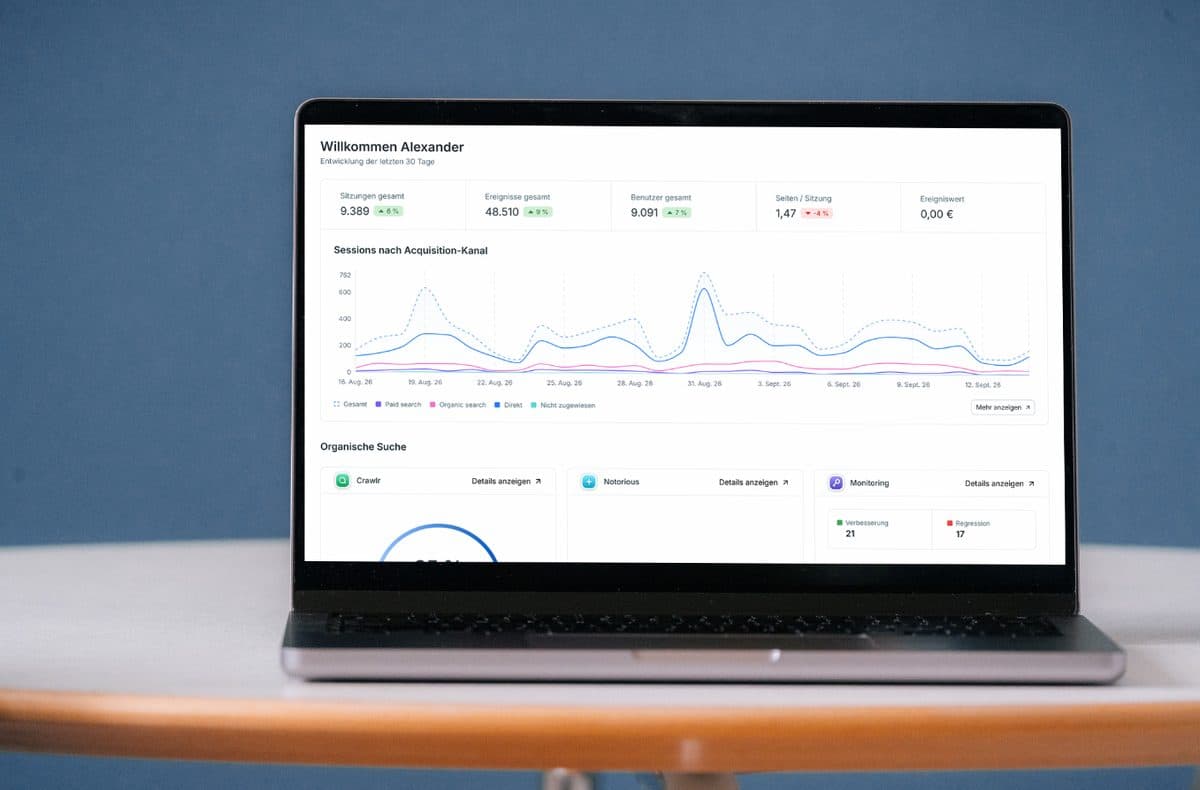
In the SEO analysis the advantage shows in the data. The CrawlR crawler captures even large domains in full, Monitoring delivers the organic position for each keyword alongside its AI Overview mention, and Notorious puts the link profile straight against the competitors ranking ahead. At the European Search Awards 2026 the group was named Best Large Integrated Search Agency, with the jury explicitly citing its early move into GEO.
FAQ
Frequently asked questions about SEO analysis.
The questions we are asked most often in a first conversation about an SEO analysis.
What does an SEO analysis give me?
It creates clarity about the starting position and shows which measures have the greatest effect. Resources then go where they count instead of being spread at random.
How does an SEO analysis differ from an SEO audit?
The terms overlap. At Semtrix, the SEO analysis means the data-driven examination with prioritised recommendations, while the broader SEO audit also looks at the site as a whole, including authority and competition.
How often should an SEO analysis be carried out?
A thorough analysis comes at the start of any strategy. Ongoing monitoring then picks up developments early. A full repeat usually makes sense after twelve to eighteen months, or before a major change.
How long does an SEO analysis take?
For a mid-sized website, the crawl, evaluation and assessment usually take two to three weeks. On very large domains or with several language versions, it is the assessment that takes longer, not the data collection.
What do you need from me?
Read access to Search Console and analytics, ideally to the content management system as well. Everything else is gathered externally. An analysis is possible without those, it is simply less precise.
Do I get a PDF or a conversation?
Both. The report documents the findings, the conversation sorts them. In our experience, the joint walkthrough decides whether an analysis is ever acted on.
Can I implement the results myself?
Yes. The roadmap is written so your team or your agency can work from it. Where Semtrix would take on delivery, that sits alongside as an offer, not a condition.
Do you analyse websites that do not rank at all yet?
Yes, and the focus of the SEO analysis then shifts. Instead of ranking trends, it centres on market potential, search intent and competitive structure, plus technical readiness to launch.
What does an SEO analysis cost?
The effort depends on the size of the website, the number of language versions and the depth of the question. The first assessment within the free analysis carries no obligation.
Does the analysis cover AI search systems?
On request the SEO analysis is extended to cover them. Through LLM Ranking we check whether your brand appears in answers from ChatGPT and Perplexity and in AI Overviews, and which sources are cited instead.
What happens if the analysis finds hardly any problems?
Then that is what the report says. On technically clean websites the leverage usually sits in content depth and authority. Inventing problems would be the fastest way to lose trust.
Does a free tool replace an SEO analysis?
Fine for a first impression, too little for a decision. An SEO analysis is more than the sum of its measurements. Tools list deviations from a norm. They do not know which keyword carries your business and which finding therefore comes first.
Free and without obligation
Let's talk about where you stand.
Personal, specific and without off-the-shelf answers. In a first conversation about your SEO analysis we work out what it should answer and what can be built on it.